
India’s Rupee Near ₹95: What a Weak Rupee Means for Investors
Welcome to the first edition of our series, What This Means for Your Money, where we translate breaking economic news into simple, comforting advice for your family. If you have been following the news, you have likely seen that the Indian Rupee is testing the ₹95–₹96 mark against the US Dollar. When our currency weakens, it is natural to wonder: Is our economy slowing down? Will my savings lose value? Should I change my investment plans?
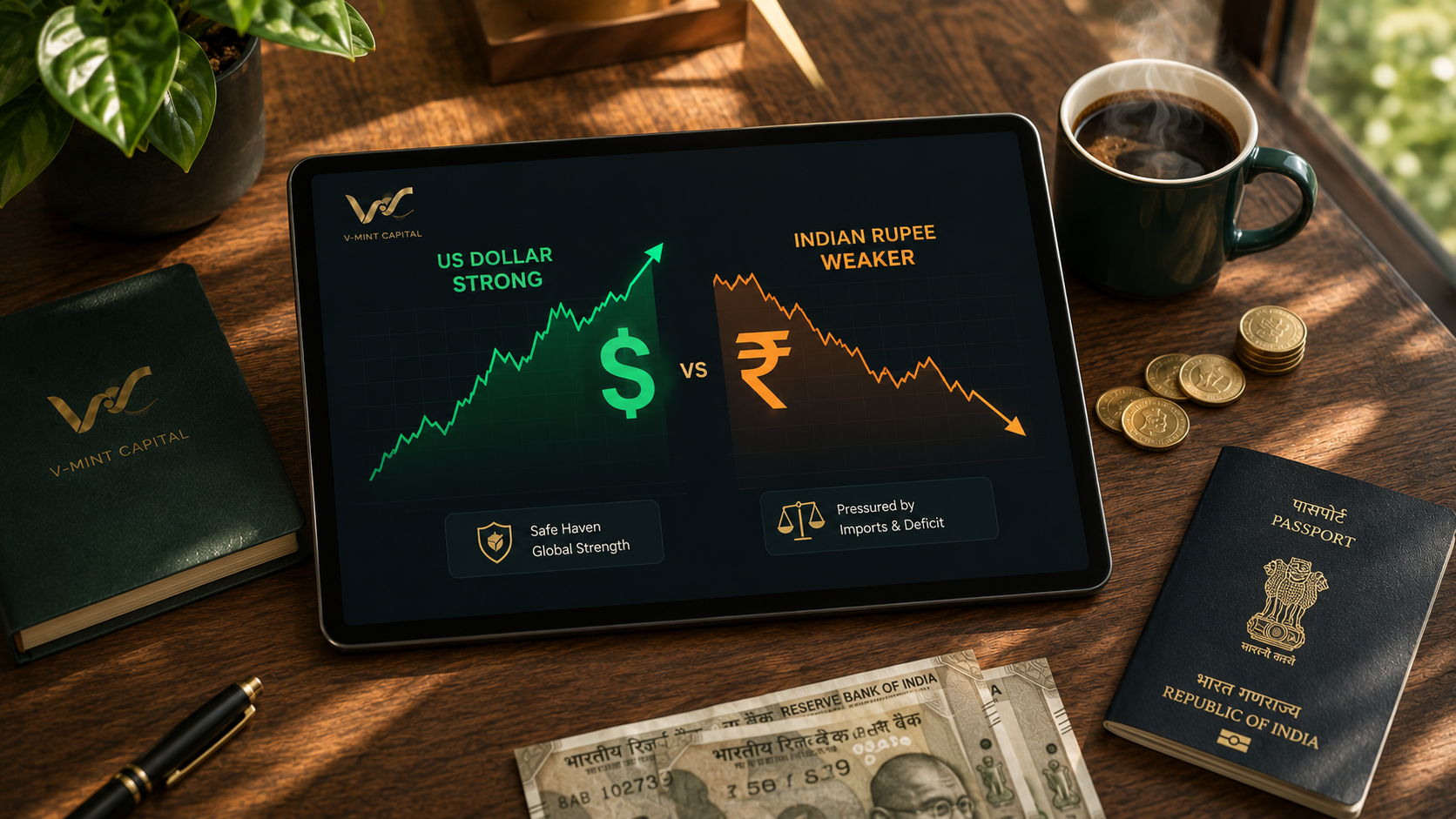
The reassuring answer is that a fluctuating currency is a normal feature of a dynamic global economy. Currency depreciation is not a sudden crash; it is an ongoing economic balancing act. Today, we break down exactly what happened, why it occurred, who is affected, and what practical steps you should take with your money.
What Happened?
Over recent cycles, the US Dollar has maintained broad global strength against most international currencies. The exchange rate has gradually moved towards the ₹95–₹96 range per Dollar. In simple terms, purchasing imported goods or foreign currency now requires more Rupees than it did a few years ago.
“Currency movement is a reflection of global trade flows. While a softer rupee naturally increases the cost of imported goods, it also provides a powerful boost to Indian exporters and increases the value of foreign remittances sent home by NRIs.”
V-Mint Capital Market OverviewWhy Did It Happen?
Currency values are determined by supply and demand across global markets. Two primary factors drive this trend:
- Global Interest Rates: When interest rates in major economies like the US remain elevated, international investors often move capital into Dollar-denominated assets. This outflow of capital creates natural downward pressure on emerging market currencies.
- Energy & Import Inflows: India is one of the world’s fastest-growing economies, which requires importing substantial amounts of crude oil and industrial commodities priced in Dollars. Buying these commodities requires selling Rupees to acquire Dollars, influencing the exchange rate.
Who is Affected? The Two Sides of Currency Movement
Currency depreciation creates distinct advantages for certain sectors while creating cost considerations for others.
Who Benefits
Export-Oriented Businesses: Companies in the Information Technology (IT) and Pharmaceutical sectors earn their revenue in foreign currencies like US Dollars or Euros. When these earnings are converted back into Rupees, their top-line revenue receives a natural lift.
Global NRIs: For Non-Resident Indians living across the United States, UAE, United Kingdom, Singapore, Canada, Japan, and Europe, a weaker Rupee means their foreign income converts into a larger Rupee corpus when sending money home to support family or invest in India.
Who Needs to Plan Ahead
Importers & Travelers: Businesses importing raw materials, electronics, or specialized machinery face higher input costs. Similarly, families planning international vacations or funding children studying abroad will find foreign expenses higher in Rupee terms.
What Changes for Everyday Families?
The primary way a weaker currency touches domestic households is through imported inflation. Higher import bills for fuel and logistics can gently raise transportation and manufacturing costs, which gradually reflect in consumer goods. This is why keeping long-term money in low-yielding bank accounts is risky—it fails to keep pace with rising living costs.
What Should You Do With Your Money?
You do not need to make sudden or drastic changes to your portfolio. A calm, structured approach ensures your wealth continues to compound smoothly:
- Stay Consistent With Your SIPs: Do not pause your Systematic Investment Plans (SIPs). High-quality Indian businesses continually adapt to economic shifts and pass on cost adjustments over time, preserving long-term profitability.
- Consider Global Diversification: Allocating a small, comfortable portion of your portfolio to International Mutual Funds creates an automatic currency hedge. When the Rupee softens against global currencies, your international holdings gain value in Rupee terms.
- Focus on Real, Inflation-Beating Growth: Long-term financial security comes from owning productive, compounding assets like diversified mutual funds that historically outperform everyday cost inflation.
Protect Your Family’s Purchasing Power
Concerned about how global currency shifts affect your family’s future? Let V-Mint Capital build a resilient, goal-aligned wealth strategy tailored to your life.
Schedule a Friendly Chat