
Form 121 Replaces 15G & 15H: New Unified TDS Guide (2026)
For decades, the end of the Indian financial year brought a familiar chore for millions of investors: the scramble to submit Form 15G or Form 15H to their banks to prevent unnecessary tax deductions on their interest income. But the landscape has fundamentally changed. Under the sweeping revisions of the Income Tax Act, 2025, the Central Board of Direct Taxes (CBDT) has permanently retired these two legacy forms. Starting April 1, 2026, they are replaced by a single, streamlined document: Form 121.
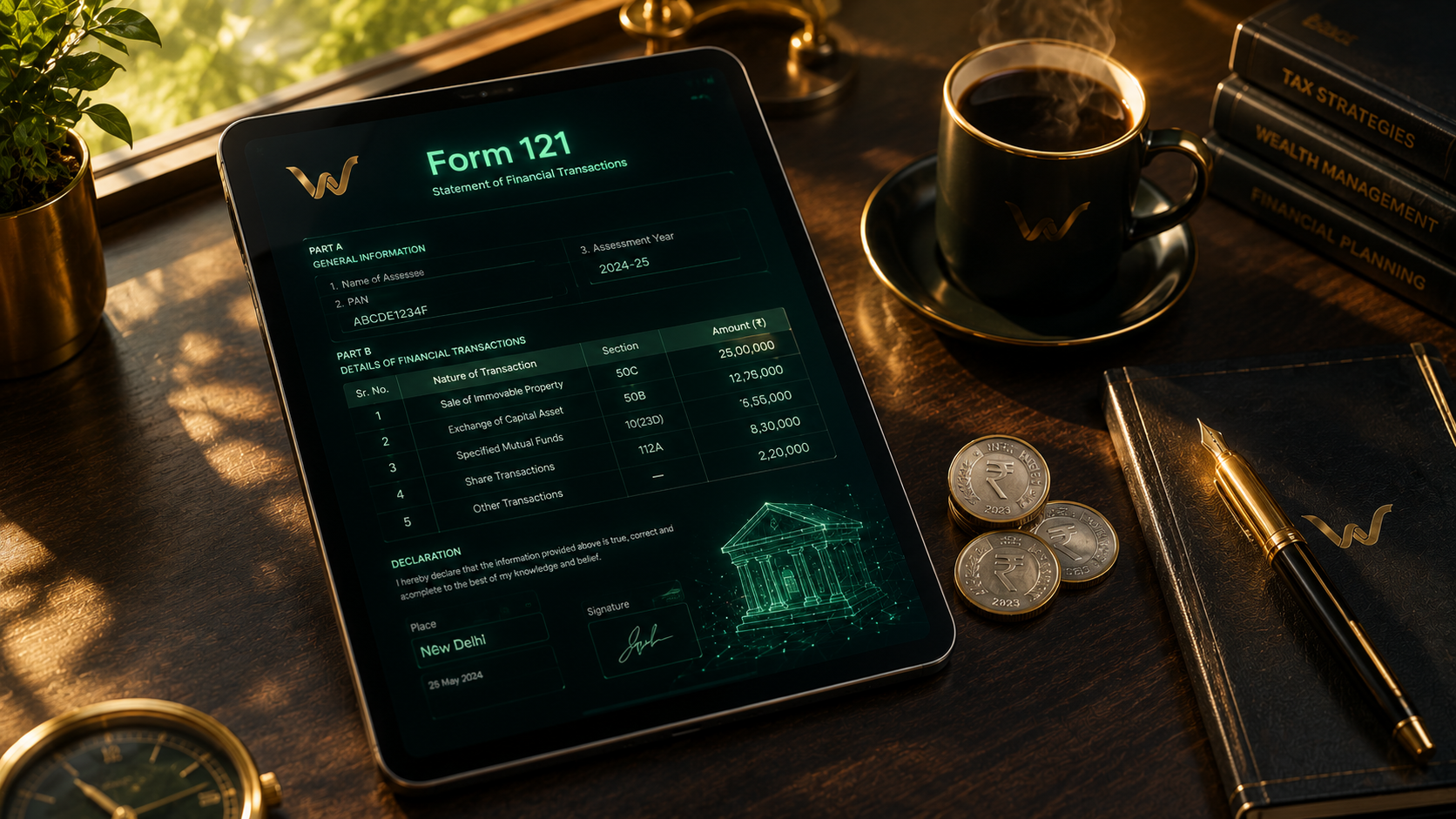
For millions of taxpayers—especially retirees, passive income earners, and conservative fixed-deposit holders—this is a massive administrative relief. However, filling it out correctly is critical. Submitting the new Form 121 incorrectly can lead to rejected declarations, sudden 10% TDS deductions, and the agonizing process of waiting an entire year to claim a refund via your Income Tax Return (ITR).
Today, V-Mint Capital breaks down exactly what Form 121 is, why the government killed 15G and 15H, who is legally eligible to file it, and how it impacts your mutual fund and fixed deposit portfolios.
“The distinction between Form 15G (for those under 60) and Form 15H (for senior citizens) was purely age-based. Both forms did the exact same job, creating needless duplication in the banking compliance process. Form 121 addresses this inefficiency by bringing all eligible taxpayers under one unified digital roof.”
Priyam Verma, V-Mint CapitalWhat is Form 121 and How Does It Stop TDS?
To understand the power of Form 121, you must first understand the mechanics of Tax Deducted at Source (TDS). When your bank, post office, or mutual fund AMC pays you a significant amount of interest or dividend, the government legally forces them to withhold a portion of that money (usually 10%) and send it directly to the Income Tax Department.
But what if your total annual income for the year is so low that you actually fall below the taxable threshold? It is entirely unfair for the bank to deduct 10% of your earnings when your final tax bill at the end of the year is going to be mathematical zero.
This is where Form 121 acts as your financial shield. It is a legal Self-Declaration form. By submitting it, you are officially promising the government and your bank: “My total estimated tax liability for this financial year is NIL. Therefore, please do not deduct any TDS from my payouts.”
The Evolution: Form 15G vs. Form 15H vs. Form 121
Previously, the Income Tax Department maintained two separate forms that caused widespread confusion. Form 15G was for individuals under the age of 60. Form 15H was exclusively for senior citizens aged 60 and above. The introduction of Form 121 under the updated 2025 Act completely strips away this age-based bureaucracy.
| Feature | Old Form 15G | Old Form 15H | New Form 121 (From April 2026) |
|---|---|---|---|
| Applicability | Resident individuals below 60 years & HUFs | Resident Senior Citizens (60+ years) | All Eligible Resident Taxpayers & HUFs |
| Age Distinction | Yes | Yes | No |
| Purpose | Prevent TDS deduction | Prevent TDS deduction | Unified prevention of TDS deduction |
| Digital Verification | Manual / Limited Digital | Manual / Limited Digital | Fully integrated via PAN & IT Portal |
Strict Eligibility: Who Can and Cannot File Form 121?
Form 121 is not a magic wand to evade taxes. It is a highly scrutinized statutory document. Submitting it when you are ineligible can trigger severe penalties.
Who CAN file Form 121:
- Resident Individuals: You must be an Indian resident for tax purposes. Both young professionals and senior citizens fall under this bucket.
- Hindu Undivided Families (HUFs): HUFs generating passive income can use the form.
- NIL Tax Liability: Your estimated final tax liability for the financial year (after accounting for all eligible deductions under Section 80C, 80D, etc.) must be strictly zero.
- Valid PAN Holders: You must possess a valid, active Permanent Account Number (PAN). Usually, this also requires your PAN to be linked with your Aadhaar card per government mandates.
Who CANNOT file Form 121:
- Non-Resident Indians (NRIs): NRIs cannot use Form 121 to avoid TDS on their NRO accounts or mutual funds. TDS is strictly applicable to non-residents under a different section of the tax code.
- Corporates and Firms: Private Limited Companies, Partnership Firms, and LLPs are strictly prohibited from using this form.
- Taxpayers Above Exemption: Anyone whose final estimated tax liability is greater than zero cannot submit this declaration.
How Does Form 121 Impact Mutual Fund Investors?
If you are a V-Mint Capital client investing in mutual funds, you need to understand exactly when Form 121 applies to your portfolio.
Dividends (IDCW Plans): If you hold mutual funds under the IDCW (Income Distribution cum Capital Withdrawal) option, the AMC is legally required to deduct 10% TDS if the total dividend paid to you exceeds ₹5,000 in a financial year. If your total income is below the taxable limit, you must submit Form 121 to your respective Mutual Fund RTA (like CAMS or KFintech) to receive your full dividend payout without a 10% haircut.
Capital Gains (Growth Plans): Form 121 does not apply to capital gains generated from selling equity mutual funds under the Growth option. Therefore, if you are running a Systematic Withdrawal Plan (SWP) or doing Capital Gains Tax Harvesting, you do not need to worry about Form 121. Equity capital gains are taxed differently upon redemption, and standard resident TDS does not apply to capital gains.
How to Submit Form 121 (The Digital Shift)
One of the primary reasons the CBDT introduced Form 121 was to streamline digital infrastructure. From April 2026 onwards, submitting the form is designed to be a frictionless online process.
- Login to your Bank/AMC Portal: Navigate to the ‘Tax Center’ or ‘Service Requests’ tab in your net banking or mutual fund app.
- Select Form 121: The option for 15G/15H will be grayed out or removed. Select the unified Form 121.
- Verify PAN and Demographics: The system will auto-populate your basic details. Ensure your PAN matches exactly. Even a slight mismatch will cause the system to reject the API call to the Income Tax portal.
- Input Estimated Income: Declare your estimated total income for the current financial year. Be honest. Do not just enter a random low number.
- Digital Signature: Authenticate using an OTP sent to your registered mobile number or via Aadhaar e-Sign.
The Danger of False Declarations
Because Form 121 is highly integrated with your PAN, the Income Tax Department tracks your declarations in real-time. If you submit Form 121 to a bank to block a TDS deduction, but later file an ITR showing a taxable income of ₹10 Lakhs, the system will immediately flag the discrepancy.
Making a false declaration in Form 121 just to avoid a temporary TDS deduction is a serious offense under Section 277 of the Income Tax Act. It can result in severe financial penalties and, in cases of deliberate evasion, prosecution. If you are unsure whether your tax liability will be zero, it is always safer to allow the bank to deduct the TDS and claim it back as a legitimate refund when you file your ITR.
Need Help Structuring a Tax-Efficient Portfolio?
Stop worrying about complex tax forms and TDS deductions. Let V-Mint Capital build a fully optimized, compounding mutual fund portfolio tailored strictly to your financial goals.
Consult Our Wealth Desk