
Demat vs Mutual Fund Account: Do You Need Both?
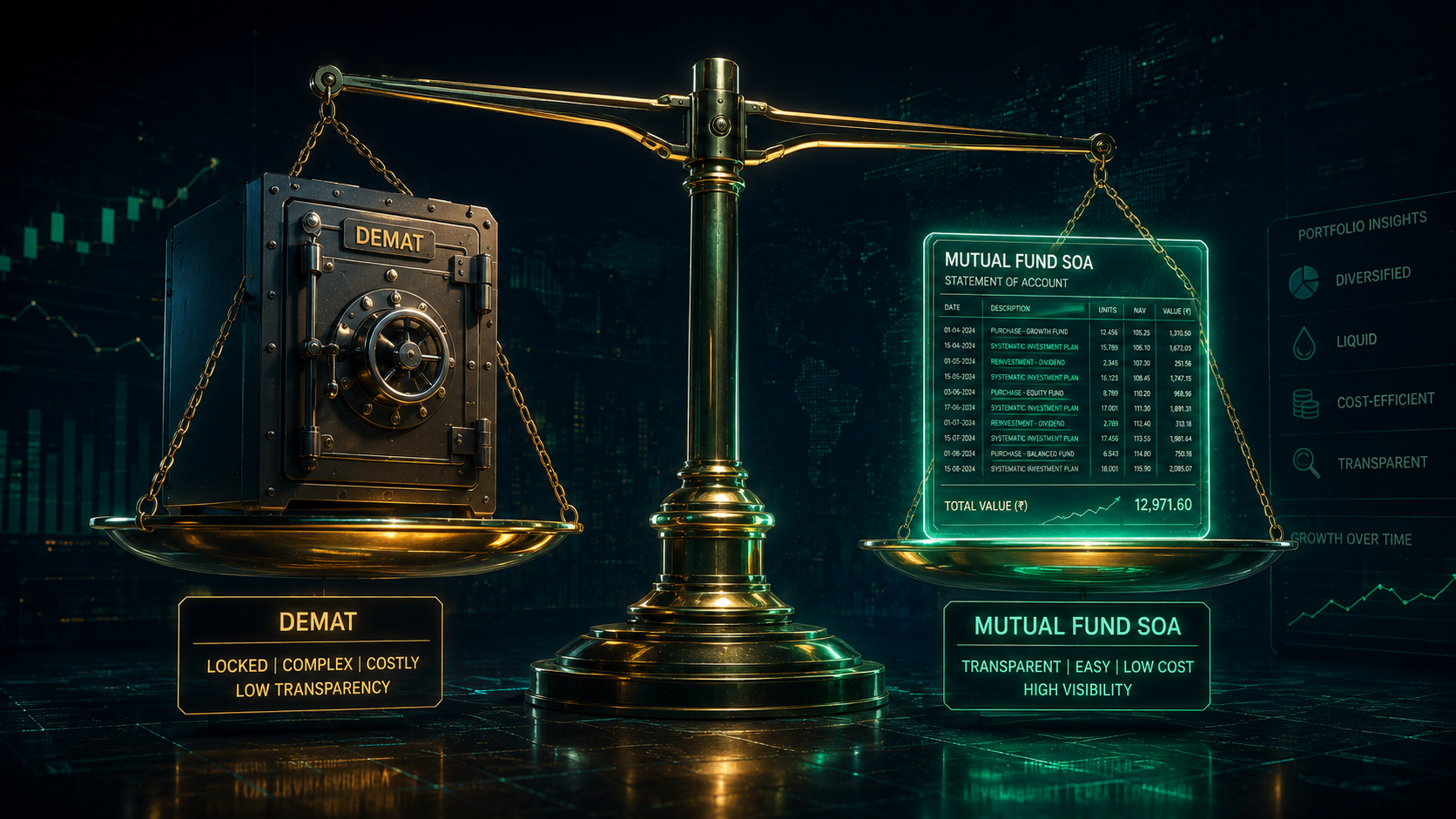
The moment you decide to start your investing journey in India, you are immediately bombarded with aggressive advertisements from discount brokers telling you to “Open a Free Demat Account Today!” This creates a massive misconception among beginners who falsely believe that a Demat account is mandatory to invest in Mutual Funds.
At V-Mint Capital, we are constantly unwinding the tangled portfolios of investors who mistakenly bought mutual funds inside a Demat account, only to get trapped by hidden fees and rigid platform rules. Here is the absolute truth about Demat accounts versus Mutual Fund SOA (Statement of Account) formats, and why you should almost never mix the two.
What is a Demat Account Actually Built For?
“Demat” stands for Dematerialized. Before 1996, if you bought shares of Reliance, you received physical paper certificates. To eliminate fraud and physical storage, the government mandated that shares must be held electronically. Thus, the Demat account was born.
A Demat account is built specifically to hold shares of direct equity. It acts exactly like a digital bank locker for your company stocks. It is maintained by Depositories (NSDL or CDSL) and accessed through your broker (Zerodha, Upstox, AngelOne, etc.).
What is the SOA (Statement of Account) Format?
Mutual funds were never designed to be held in a Demat locker. By native design, when you buy a Mutual Fund, your ownership is recorded directly on the servers of the Registrar and Transfer Agents (RTAs) like CAMS or KFintech.
Instead of a Demat account number, you are issued a Folio Number. This is your unique Mutual Fund Account. This format is called the SOA (Statement of Account) format. It is completely digital, flawlessly tracked, and universally accessible.
The 4 Hidden Dangers of Holding MFs in Demat
Discount brokers aggressively push you to buy mutual funds through their Demat platforms because it benefits them, not you. Here are the major disadvantages:
- 1. Hidden Annual Maintenance Charges (AMC): SOA formats are 100% free to hold. Demat accounts charge an Annual Maintenance Fee (ranging from ₹300 to ₹1000+ per year) just to keep the locker open.
- 2. Depository Participant (DP) Charges: Every time you sell a mutual fund unit from a Demat account, the broker slaps a “DP Charge” (approx ₹15 to ₹25) per transaction. Over a lifetime of SIPs and withdrawals, this bleeds your returns. The SOA format has zero DP charges.
- 3. The Platform Lock-In Trap: If you buy mutual funds in SOA format, your portfolio is universally portable. You can log into the AMC website directly, use MFUtility, or switch to an advisor like V-Mint Capital seamlessly. If you hold them in a Demat account, you are held hostage. To move away from your broker, you have to execute a highly complex, offline “Off-Market Transfer” process that takes weeks.
- 4. Transmission & Nomination Nightmares: Updating nominations or transferring mutual fund units to heirs upon death is significantly smoother directly with the RTA (CAMS) in SOA format compared to navigating Demat legalities.
How V-Mint Capital Executes Without Demat
At V-Mint Capital, we utilize institutional-grade transaction platforms like BSE StAR MF and NSE NMF II. When we set up your SIP or execute a lumpsum transaction, the mutual fund units are credited directly to your Folio Number in the pristine SOA format.
You receive direct confirmations from the AMC (like HDFC or SBI) and the RTA (CAMS). You bypass all depository charges, lock-ins, and maintenance fees while still getting a beautifully consolidated, single-dashboard view of your entire wealth on our Client Platform.
The Final Verdict: Do You Need Both?
| Your Goal | Account Required | Why? |
|---|---|---|
| Direct Stock Trading / IPOs | Demat Account | Mandatory by law to hold company shares. |
| Mutual Fund SIPs & Lumpsums | SOA (Folio) Format | Zero AMC, zero DP charges, highly portable, fraction-friendly. |
| Sovereign Gold Bonds (SGBs) | Both work | Demat allows secondary market trading; SOA allows simple holding till maturity. |
If you intend to trade direct stocks, you absolutely must open a Demat account. However, you should strictly keep your Mutual Fund investments completely separate from that Demat account. Run your SIPs purely in the native SOA format to protect your compounding wealth from unnecessary structural friction.
Start Investing Without Hidden Demat Fees
Are your mutual funds trapped in a restrictive Demat account? V-Mint Capital helps investors migrate to the superior, zero-fee SOA format seamlessly. Contact us to restructure your portfolio correctly.
Restructure Your Portfolio