
How RBI Monetary Policy Impacts Your Investments
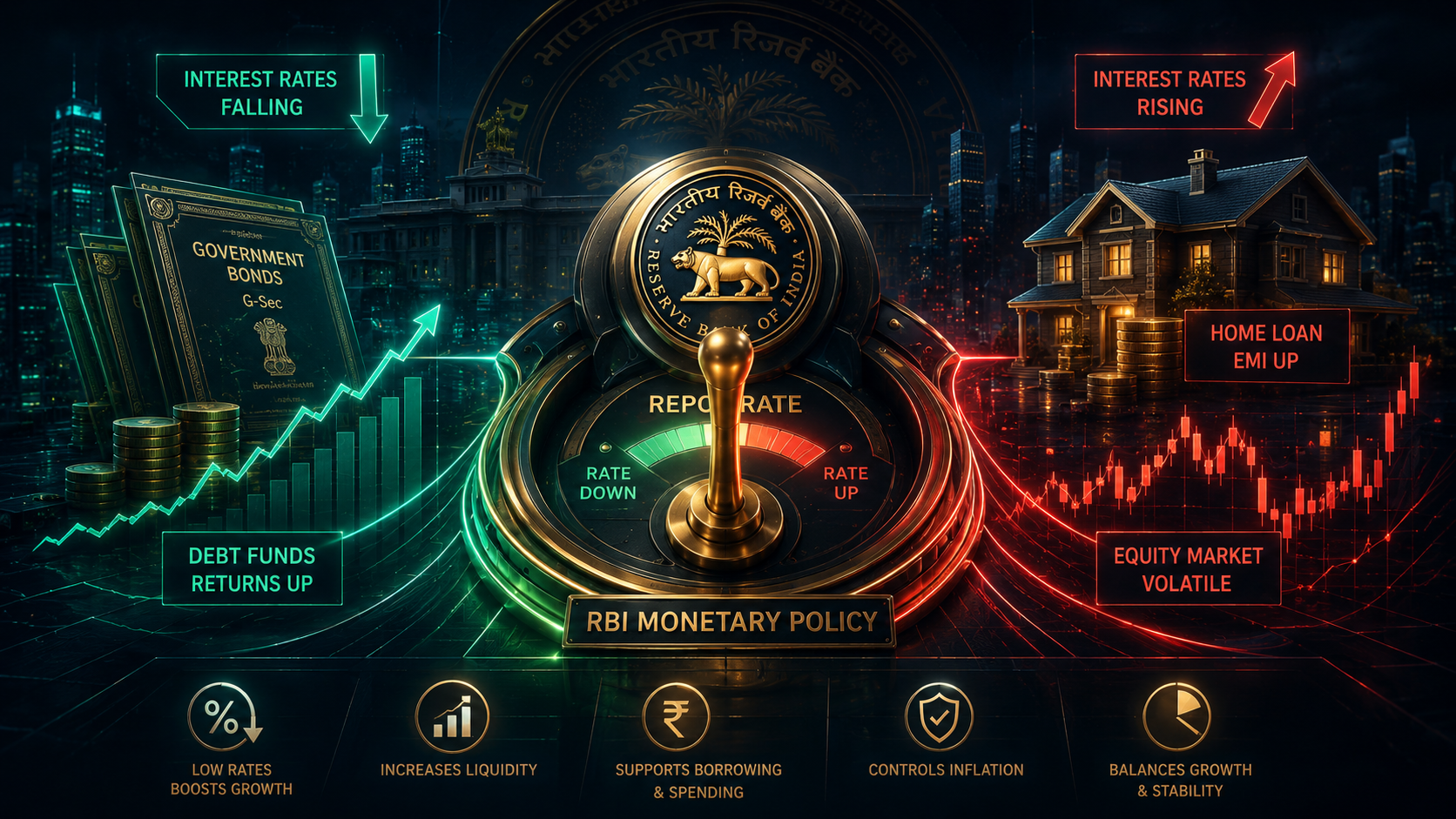
Every two months, financial news headlines across India obsess over a single event: the Reserve Bank of India (RBI) Monetary Policy Committee decision. While economic terms like “Repo Rate” and “CRR” might sound complex, the RBI’s choices directly dictate how much interest you pay on your home loan and what kind of returns your mutual funds generate.
Whether you are paying off a home mortgage, managing an active mutual fund portfolio, or planning for retirement, understanding how RBI monetary policy works is essential for protecting and growing your hard-earned capital.
What is RBI Monetary Policy and Why Should You Care?
The Reserve Bank of India acts as the central bank and economic referee for the country. Its primary responsibility is maintaining a delicate balance: keeping inflation under control while helping the Indian economy grow.
Think of monetary policy as the accelerator and brake pedal of the Indian economy:
- When Inflation is Too High: The RBI steps on the brake by making borrowing more expensive, which slows down excess spending.
- When Economic Growth Slows: The RBI steps on the accelerator by cutting interest rates, making loans cheaper to encourage businesses and individuals to spend and invest.
The Core Weapon: Understanding the Repo Rate
The RBI’s primary tool for steering the economy is the Repo Rate. This is the interest rate at which commercial banks borrow money from the RBI.
Impact 1: How RBI Policy Moves Your Home Loans & EMIs
If you have an active home loan, floating interest rates are directly linked to the Repo Rate through an External Benchmark Lending Rate (EBLR) mechanism.
- When RBI Hikes Rates: Banks instantly increase home loan interest rates. To keep your monthly installment manageable, banks often extend your total loan tenure, meaning you end up paying lakhs more in total interest over time.
- When RBI Cuts Rates: Your home loan interest rate drops, lowering your total interest burden and shortening your repayment timeline.
Whenever rate cycles shift, run your revised interest rates through our Home Loan EMI Calculator. Seeing how a 0.5% rate shift affects your total interest helps you evaluate whether you should make principal prepayments or execute a loan balance transfer to a more competitive lender.
Impact 2: What Happens to Your Mutual Fund Portfolio?
RBI interest rate decisions affect equity and debt mutual funds in completely different ways:
A. Debt Mutual Funds (The Inverse Relationship)
Debt mutual funds invest in government bonds and corporate fixed-income securities. Bond prices and interest rates move in opposite directions:
- When RBI Cuts Rates: Existing bonds paying older, higher interest rates become extremely valuable. Their market prices shoot up, delivering strong capital gains and higher NAVs for debt fund investors.
- When RBI Hikes Rates: Newer bonds come to market paying higher yields, making older bonds less attractive. Short-term debt fund returns may slow down temporarily.
B. Equity Mutual Funds (Stock Market Realities)
When the RBI hikes rates, borrowing becomes expensive for businesses, which can temporarily reduce corporate profit margins and slow stock market rallies. However, over a longer horizon, disciplined SIP investments driven by strong Indian corporate earnings comfortably absorb rate cycles and beat inflation.
How Smart Investors Reposition Wealth During Rate Shifts
Instead of panicking during RBI rate changes, disciplined investors adjust their plans strategically:
- Optimize Loan Expenses First: Don’t let rising home loan EMIs crowd out your monthly savings. If borrowing costs spike, consider utilizing a Loan Against Securities for short-term liquidity needs instead of taking high-cost unsecured personal loans.
- Maintain Your Retirement Discipline: Macroeconomic cycles come and go. Check your long-term timeline using our Retirement Calculator to stay focused on wealth creation rather than short-term market noise.
- Build a Tax-Efficient Income Stream: If you rely on investments for monthly cash flow, fixed deposits can become heavily taxable during rate hikes. Setting up a Systematic Withdrawal Plan (SWP) allows you to generate steady income with significantly better tax efficiency.
Align Your Portfolio With Rate Cycles
Navigating shifting RBI interest rates shouldn’t be a guessing game. Let V-Mint Capital optimize your loans and mutual fund asset allocation to keep your wealth compounding smoothly in any economic environment.
Consult an Expert Today